The Simple Strategy
Ljubljana works best when transport stays in the background. Stay close to the river/Old Town, do most of the center on foot, and use bikes or buses only when you’re heading to parks and outer neighborhoods.
Rule of thumb: if you’re in the center, walking is usually faster than figuring out transit—and it’s prettier.
Arriving in Ljubljana
From the Airport (LJU)
The most straightforward options are a transfer/shuttle or a taxi. Public transport can work too, but it’s worth checking schedules and routes before you commit—especially if you’re arriving late.
- • Easiest: pre-booked shuttle/transfer (good with luggage).
- • Fastest: taxi (best if you value door-to-door simplicity).
- • Lowest cost: public transport (plan around timetables).
- • Most flexible: rental car (mainly useful if you’ll road-trip Slovenia).
By Train or Long-Distance Bus
Ljubljana’s main station area is close to the center. If you’re staying in Old Town, you can usually walk (especially in good weather), or take a short taxi ride if you have luggage.
Getting Around the City
Walking (Best Default)
For most itineraries, walking is the whole plan: bridges, market arcades, castle hill routes, and the river loop all connect naturally. Comfortable shoes matter more than apps.
Bikes + Electric Shuttles
Bikes are great for Tivoli, Šiška, and quick hops across town. In the pedestrian zone, the small electric shuttle service is useful if you want a lift without leaving the car-free core.
City Buses
Buses are most useful for residential areas and museum/park days outside the central loop. If you’re staying in Old Town, you might only use them once or twice—or not at all.
Train + Bus Stations
Ljubljana’s main train and bus stations are close to the center and to each other. If you’re arriving with luggage, it can be easiest to take a short taxi ride to Old Town; if you’re traveling light, many people simply walk.
If you’re undecided: book accommodation you can reach easily from the station/airport, then spend your days mostly on foot. That choice removes 80% of transport friction.
Walking Distances Between Key Points
The reason walking is the default in Ljubljana is simply that the distances are tiny. The whole inner city is built around the loop of the Ljubljanica river, and once you grasp that, the map almost reads itself. Take Prešeren Square, beside the Triple Bridge, as your reference point and most of what you came to see is only a few minutes away on foot. The figures below are approximate strolling times at a relaxed pace—treat them as a feel for the geography rather than exact measurements.
- • Prešeren Square to the Dragon Bridge: a short walk along the riverside, just a few minutes.
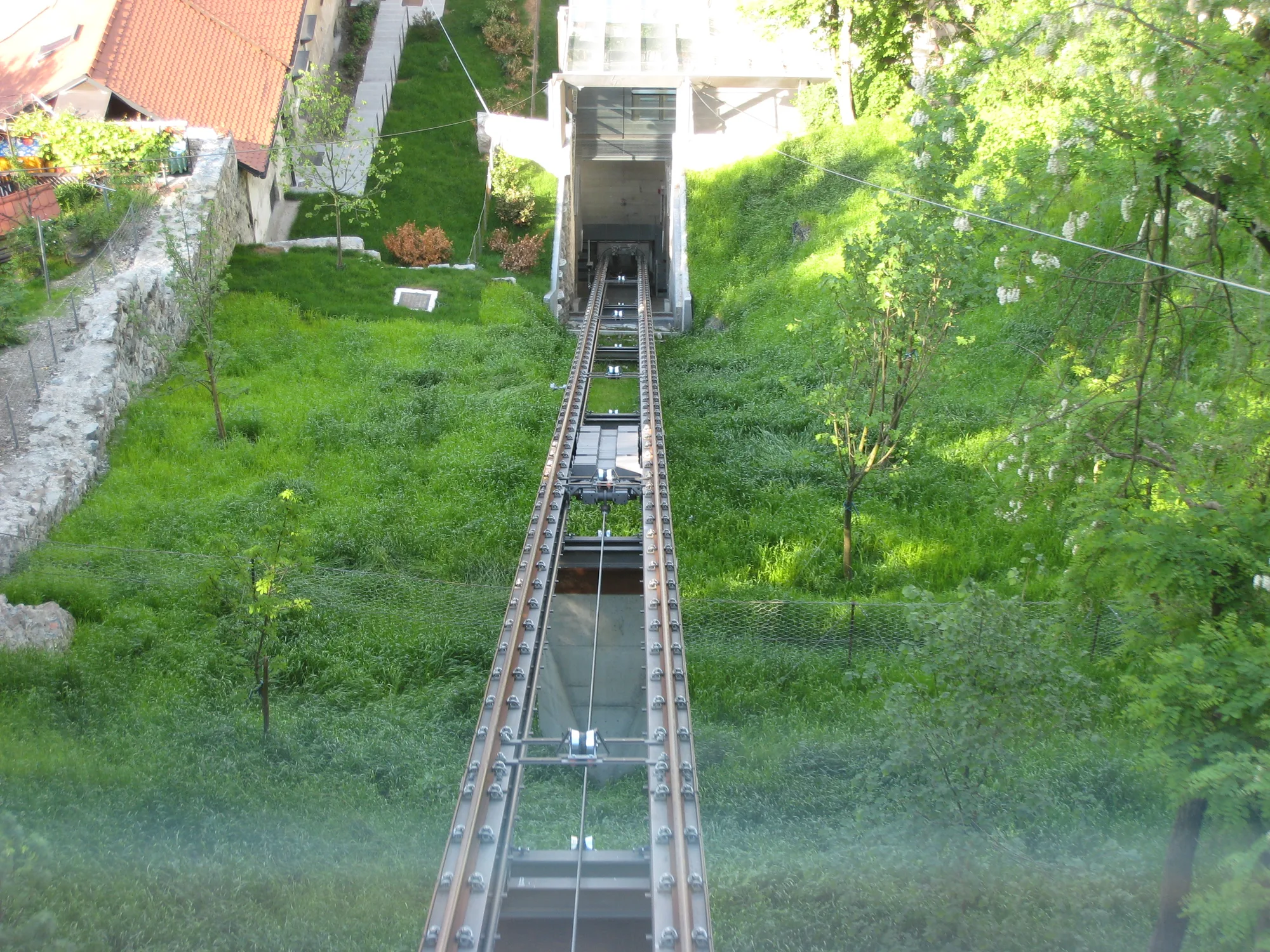
- • Prešeren Square to the Central Market & castle funicular: only a few minutes to the foot of Castle Hill, where the funicular climbs from near Krekov trg.
- • Old Town to Trnovo & Krakovo: roughly 10–15 minutes south, mostly along the water or through garden lanes.
- • Center to Tivoli Park: around 10–15 minutes northwest, a flat and easy walk into the city’s biggest park.
- • Center to the main train & bus stations: about 15–20 minutes north—walkable with light luggage.
- • Center to Metelkova & the Tabor district: roughly 10–15 minutes toward the station area.
Because the river threads through everything, the prettiest route is frequently also the most direct, and you can plan a full day of sightseeing without once working out a bus. If you would like those distances drawn out as actual itineraries, see our walking routes guide and the is Ljubljana walkable? page.
The Pedestrian Zone & the Kavalir Shuttles
The defining feature of central Ljubljana is that it is essentially car-free. Over the years the city closed its historic core to through traffic, and the result is one of the most pleasant urban centers in Europe to explore on foot—part of what earned Ljubljana its European Green Capital status. You can wander from the river to the squares to the market without ever stepping into the path of a car, which makes the whole experience calmer, quieter, and far more walkable than the same streets would be otherwise.
Inside that pedestrianised zone, the city runs a small fleet of free electric vehicles known as Kavalir. These are slow, friendly, open-sided buggies that ferry people short distances within the car-free core. You can flag one down or ask the driver for a lift, and there is no charge. They are genuinely useful if you are carrying luggage, if you have tired feet at the end of a long day, or if walking the cobbles is difficult—they are designed precisely so that everyone can reach the heart of the city even where ordinary cars are not allowed.
Do not think of Kavalir as a way to cross town quickly—it is deliberately leisurely and confined to the center. Think of it instead as a thoughtful little convenience that keeps the pedestrian zone accessible. For the full picture of how it works and where it runs, see our Kavalir shuttle guide.
Taxis & Ride-Hailing
For most of your time in Ljubljana you simply will not need a taxi—the center is too compact and too walkable to justify one. But there are moments when a ride makes sense: arriving or leaving with heavy luggage, getting back to your accommodation late at night, reaching an outer neighborhood quickly, or making the run to the airport. Taxis operate throughout the city, and ride-hailing apps are available too, which many visitors find the easiest way to get a clear, up-front price.
A sensible habit, especially if you hail a cab on the street rather than booking through an app, is to confirm that the meter is running or to agree the fare before you set off. App-based rides usually show the price in advance, which removes the guesswork. Fares are modest by Western European standards for short in-city hops, though taxi rates differ between operators, so an app price or a quick word with the driver about the meter saves any surprises.
For the airport in particular, a pre-booked transfer or a taxi is the most straightforward door-to-door option. Our airport transfer guide walks through the choices, and the broader getting to Ljubljana page covers arrival from further afield.
Driving & Parking (If You Have a Car)
A car is rarely an asset inside Ljubljana, and frequently a liability. The historic center is largely closed to traffic, so you cannot drive up to most of the sights, hotels in the core may not have parking, and the streets you would most want to see are exactly the ones reserved for people on foot. If your trip is focused on the city itself, you will have a more relaxed time without a car at all.
Where a car does earn its keep is for road-tripping the rest of Slovenia—the lakes, the mountains, the coast, and day trips that are awkward by public transport. If you do drive in, the usual approach is to leave the car in a parking garage on the edge of the center, or to use a park-and-ride facility on the outskirts and continue into the middle on foot, by bus, or by bike. Parking zones, rules, and prices change, so confirm the current details and any garage locations before you arrive rather than improvising on the day.
In short: enjoy the car for Slovenia’s scenery, but park it and switch to your feet once you reach Ljubljana. Our parking near the Old Town guide goes into the practicalities, and the day trips guide helps you decide when a car is actually worth it.
Accessibility Notes
Ljubljana’s center is, on the whole, an easy place to get around. It is flat, compact, and largely pedestrianised, which removes much of the traffic and crossing stress that complicates other cities. The free Kavalir electric shuttles are a real help for shorter distances within the car-free zone, and because so much is within a few minutes’ walk, you can often plan a satisfying day without long stretches of movement at all.
There are a few things to keep in mind. Parts of the Old Town are cobbled, which can be tiring or tricky for wheelchairs, prams, and anyone unsteady on their feet. Ljubljana Castle sits on a hill, so the funicular from near the Central Market is the comfortable way up rather than the steep paths. Older buildings vary in how accessible their interiors are, and not every venue is fully step-free. If you have specific requirements, the most reliable approach is to confirm details directly with individual sights, hotels, and restaurants, and to consult the official Visit Ljubljana travel information, which keeps accessibility guidance up to date.

The Ljubljana Card: Is It Worth It?
The Ljubljana Card is a tourist pass that bundles together a number of attractions and transport perks into a single time-limited ticket. Whether it pays off depends almost entirely on how you travel. The card tends to make sense for visitors who plan to pack in several paid sights, use public transport more than a little, and generally move at a busy, see-everything pace—in that scenario the bundled admissions and rides can add up to more than the card costs.
It makes far less sense if your style is to wander, sit by the river, and dip into only a couple of museums. Because the center is so walkable, many visitors barely use city transport at all, and if you are not racking up paid admissions the card can end up costing more than you would have spent à la carte. The honest answer is to sketch out your likely sights and rides first, then do the simple arithmetic against the current card price.
Prices, inclusions, and validity periods shift from season to season, so it is worth a quick look at the latest terms when you decide. Our dedicated Ljubljana Card guide breaks down what is included and who tends to benefit, and you can cross-check your plans against the things to do and museums guides.
Sample Half-Day Transport Plans
To make all of this concrete, here are a few simple half-day shapes that show how little transport Ljubljana actually demands. Each one assumes a base in or near the center and leans on walking, with a bike or bus only where it genuinely saves time.
Classic Old Town Morning (all on foot)
Start at Prešeren Square, cross the Triple Bridge, and follow the river to the Central Market. From there ride the funicular up to Ljubljana Castle, take in the views, and walk back down into the Old Town for lunch. You will not touch any transport beyond the funicular—the whole morning is a stroll. Pair it with our Old Town guide.
Parks & Green Edges (walk + bike)
Walk northwest into Tivoli Park, climb gently toward Rožnik hill if you fancy a longer loop, then pick up a BicikeLJ bike to ride out to Koseze Pond for a quiet circuit before cycling back. Bikes turn a string of green spaces into one easy afternoon. See the Tivoli Park guide for routes.
Culture & Creative Quarter (walk + a short bus)
Spend the morning in a museum or two, then walk—or hop a single LPP bus paid with your Urbana card—out toward the Tabor district to see Metelkova’s street art and alternative venues. It is the one plan where a bus might shave off a few minutes. The Metelkova and museums guides fill in the details.
Day Trips: Keep Logistics Light
Day trips are easy to add, but the best ones feel simple: start early, pick one main highlight, and leave a buffer for getting back to Ljubljana for dinner.
If you’re visiting an iconic spot in peak season, treat morning as your “quiet window” and plan a slower afternoon back in the city.
Public transport tip: if you plan to do day trips by bus or train, choose accommodation with an easy route to the main station—then keep your other days walkable in the Old Town/riverside core.
Transport FAQs
Is Ljubljana walkable?
Yes—especially the Old Town and riverfront core. If you stay central, many “must-see” spots are an easy walk, and the pedestrian zone keeps the vibe relaxed.
How do you get from Ljubljana Airport to the city center?
Most visitors use a pre-booked shuttle/transfer or a taxi. The public bus (route 28) is the cheapest option but runs infrequently, so it suits relaxed daytime arrivals more than tight connections; it is worth confirming the current timetable when you plan a late or early flight.
Do you need a car in Ljubljana?
Not for the city. A car can help for certain day trips, but many popular places are reachable by bus, train, or organized tours—especially if you start early and keep plans simple.
What’s the easiest way to use city buses?
Buy a reusable Urbana card (€2) from a kiosk, news-stand, or tourist office, load it with credit, and tap on as you board — a single ride is €1.50 and covers up to 90 minutes with free transfers. If you’re mostly in the centre, you may not need buses at all.
How far is the main bus/train station from the Old Town?
It’s close enough to walk for most people (roughly 15–20 minutes to the central squares), and it’s an easy short taxi or bus ride if you have luggage.
What is the Kavalir electric shuttle and how does it work?
Kavalir is a fleet of small, free electric vehicles that ferry people short distances inside Ljubljana’s pedestrianised, car-free center. You can wave one down or ask a driver for a lift between points where ordinary cars cannot go—handy for tired legs, luggage, or anyone with limited mobility. It is slow by design and meant for the core only, not for crossing the whole city.
How do BicikeLJ public bikes work for visitors?
BicikeLJ is Ljubljana’s public bike-share system, with docking stations dotted across the city. You register for a €1 weekly subscription, then pick up a bike at one station and return it to another. The first hour of every ride is free; after that it is €1 for the second hour, €2 for the third, and €4 for each hour beyond — so it rewards short A-to-B hops rather than all-day rentals. It is worth a quick look at the official BicikeLJ site for the latest registration steps when you sign up.
Can you use taxis and ride-hailing apps in Ljubljana?
Yes—taxis operate in the city and ride-hailing apps are available too. For longer trips it is wise to agree or confirm the fare or use a metered/app price rather than an unmetered street pickup. For most central sightseeing you simply will not need them, but they are useful late at night, with luggage, or for the airport run.
Where can you park if you drive into Ljubljana?
The historic center is largely car-free, so driving right up to the Old Town is not really an option. Most drivers leave the car in a parking garage on the edge of the center or use a park-and-ride facility and continue on foot, by bus, or by bike. Parking zones and tariffs do change, so it is worth a quick check on the city’s parking pages when you plan your route in.
Is Ljubljana accessible for travellers with reduced mobility?
The flat, pedestrianised center is broadly easy to move around, and the free Kavalir electric shuttles can help with short distances in the car-free zone. That said, some surfaces are cobbled, the castle sits on a hill (reached by funicular), and older buildings vary in accessibility. If you have specific needs, it is worth confirming details with individual venues and the official Visit Ljubljana travel information in advance.
A Small Timing Tip
Expect reduced hours on weekends and holidays for some smaller places, and remember that museums often have a weekly closing day. If a place matters to you, check current hours before you build your day around it.
Next reads Pair this page